-
1067
A name in a chronicle
The Primary Chronicle tells of a battle on the Niamiha (Nemiga) river on 3 March 1067, and names the town as Menesk. Minsk counts its age from that year.
Source Wikipedia: Minsk · Wikipedia: Battle on the Nemiga River
-
1101
A principality of its own
From 1101 Minsk was the seat of its own principality, one of the small states that grew out of the Principality of Polotsk. Its wooden castle stood on an island where the Niamiha meets the Svislach.
Source Wikipedia: History of Minsk · Wikipedia: Minsk Castle
-
1499
Town rights
By now part of the Grand Duchy of Lithuania, Minsk received Magdeburg rights in 1499: a charter that let its townspeople govern themselves. Trade gathered at the Lower Market, just outside the castle walls.
-
1569
A new town on the hill
After the Union of Lublin in 1569, Minsk was part of the Polish-Lithuanian Commonwealth, as the centre of its own voivodeship. The Upper Town grew up around a new market square on the high bank, with Trinity Suburb across the river.
Source Wikipedia: Minsk · Wikipedia (ru): Vysoki Rynak · Wikipedia: Trinity Suburb
-
1600–1642
Stone on the square
A town hall rose on the market square in 1600, and from 1633 to 1642 the Bernardine nuns built the twin-towered church that is now the Holy Spirit Cathedral. The town hall you see today is a rebuild from 2002 to 2004.
Holy Spirit Cathedral Town Hall
Source Wikipedia (ru): Minsk Town Hall · Wikipedia (ru): Holy Spirit Cathedral
-
1793
Part of the Russian Empire
After the Second Partition of Poland in 1793, Minsk became part of the Russian Empire. From 1796 it was the centre of the Minsk Governorate.
Source Wikipedia: History of Minsk
-
1801
A straight new street
The city's first plan was adopted in 1800, and in spring 1801 Zakharyevskaya Street was laid out over the old ramparts south-east of the old town. It is the first stretch of today's Independence Avenue.
-
1871–1873
A railway crossroads
The Moscow to Warsaw railway reached Minsk in 1871, and the Libau to Romny line crossed it in 1873. The town grew fast: the 1897 census counted about 91,000 people, up from about 27,000 in 1860.
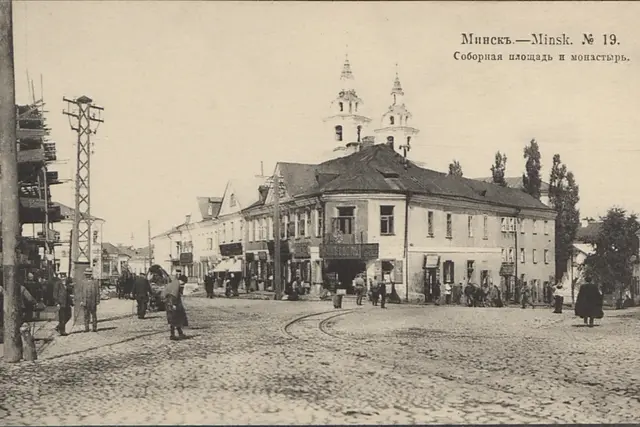
The upper market square, today Freedom Square, before 1914. Postcard · Public domain, Wikimedia Commons -
1919
A capital
In January 1919 Minsk became the capital of the Byelorussian SSR, which in 1922 was one of the founding republics of the USSR.
Source Wikipedia: Minsk
-
1921
A university
Belarusian State University was founded on 30 October 1921, and Minsk began to fill with students.
-
1941–1944
Occupation
German forces occupied Minsk from late June 1941 until 3 July 1944. In the Minsk Ghetto, from July 1941 to October 1943, between 80,000 and 100,000 Jews were imprisoned, and most of them were murdered.
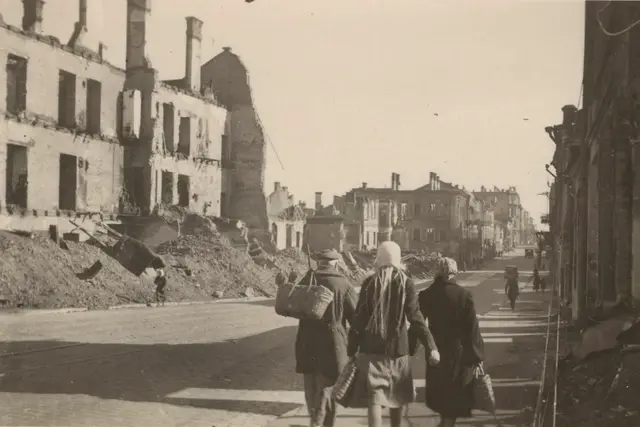
Zacharaŭskaja Street, today Independence Avenue, in 1941. Public domain, Wikimedia Commons Source Wikipedia: Minsk Ghetto · USHMM Holocaust Encyclopedia: Minsk
-
1944
A city in ruins
When the occupation ended on 3 July 1944, about 80% of the city's houses had been reduced to rubble. Only about 50,000 people were still living there.
Source Wikipedia: Minsk · Archives of Belarus
-
1947–1953
Built again, on a grand scale
From 1947 a wide new main avenue was laid out under the architect Mikhail Parusnikov, and in 1953 the twin towers of the Gates of Minsk were finished opposite the railway station. Together they gave the centre the look it still has.
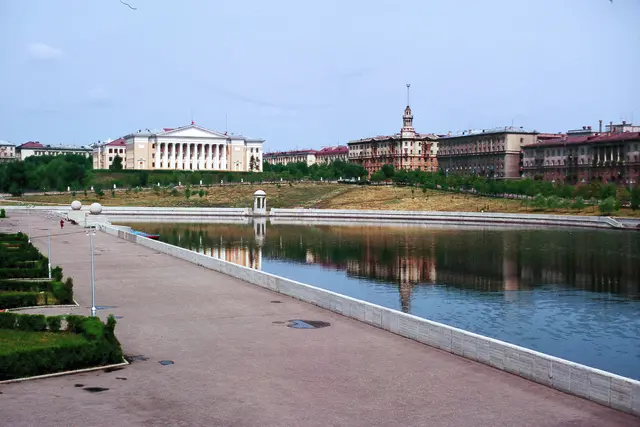
The rebuilt centre on the Svislach, 1964. Photo Jacques Dupakiers · Wikimedia Commons · CC BY 2.0 Gates of Minsk Independence Avenue
Source Wikipedia (ru): Independence Avenue · Wikipedia (ru): Gates of Minsk
-
1956–1972
A city of a million
From 1956 to 1963 a ring road about 56 km long was built around the city. In 1972 the population passed one million, and new housing districts kept growing towards the ring.
Source Wikipedia: MKAD (Minsk) · Wikipedia: History of Minsk
-
1980–1985
Trinity Suburb restored
The western part of Trinity Suburb was restored from 1980 to 1985, the first full restoration of a historic quarter in Belarus. Its 19th-century streets now hold small museums, shops and cafés.
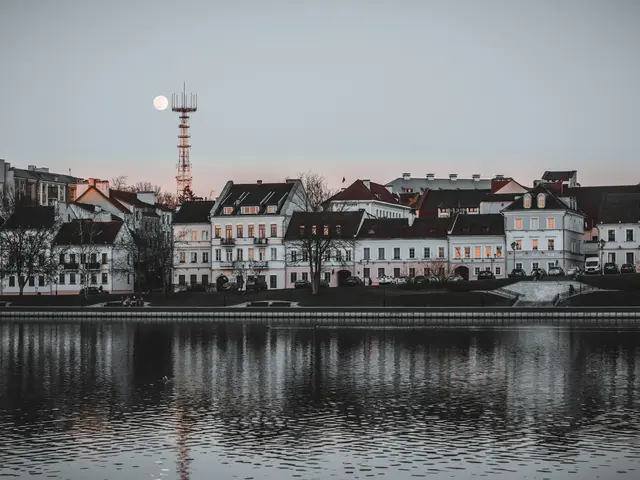
Photo Irina Pavlova · Unsplash Source Wikipedia: Trinity Suburb · Wikipedia (ru): Trinity Suburb
-
1984
The metro opens
On 29 June 1984 the first line opened: 7.84 km and eight stations, from Instytut Kultury to Maskoŭskaja. Its first riders said they felt they were in underground palaces.
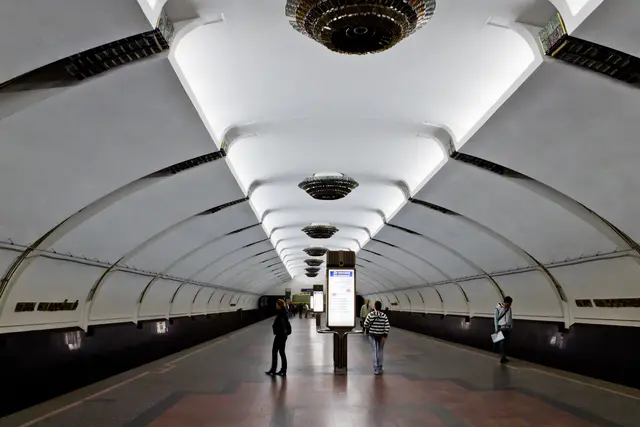
Park Čaliuskincaŭ, one of the eight stations of 1984. Photo Antares 610 · Wikimedia Commons · CC BY-SA 3.0 Source Minsk Metro: history
-
1991
Capital of independent Belarus
Since 1991 Minsk has been the capital of the independent Republic of Belarus.
Source Wikipedia: History of Minsk
-
2006
The diamond library
On 16 June 2006 the National Library opened in its new home out along the avenue: a 23-storey glass rhombicuboctahedron about 74 m tall. After sunset its facade becomes a screen of 4,646 LED fixtures.
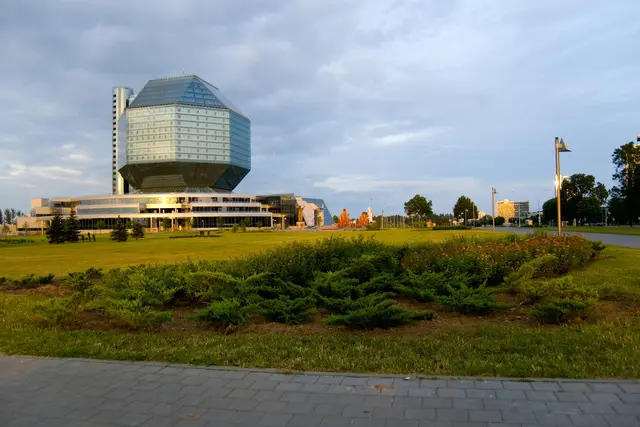
Photo Maksym Diachenko · Unsplash Source Wikipedia: National Library of Belarus · Media Architecture Biennale
-
2020–2024
A third line
Line 3 opened on 6 November 2020 with four stations, and three more followed on 30 December 2024. The metro now has 3 lines and 36 stations.
Source Minsk Metro: history · Minsk Metro: today
-
2026
About two million
On 1 January 2026, 1,995,091 people lived in Minsk. The town first named beside a small river in 1067 now covers about 410 square kilometres.
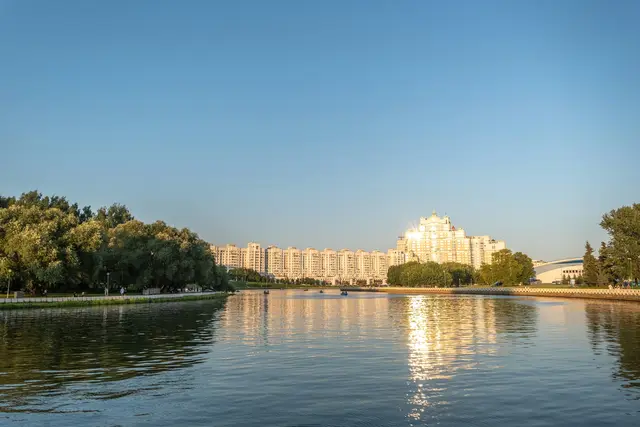
Photo Ant Rozetsky · Unsplash
History · 1067 to today
959 years in one scroll
From a battle on a small river to a city of two million. Twenty moments, told plainly, each with its source. Scroll slowly and watch the map grow.
.jpg)
_(5).jpg)


Now come and see it.
Every source on this page, with the date it was read, is listed on the sources page.